 Español
 English
 Deutsch
The return to school means an increase in digital activity, both for families and educational institutions. So, the return to school also means the return of cyberattacks.
Cybercriminals take advantage of this period to launch campaigns targeting students, parents and teachers.
These are some of the most common attacks at back-to-school time:
- Phishing disguised as school communications. They usually send fraudulent emails requesting payment of an outstanding bill. Once victims agree, their credentials may be exposed.
- Another commonly used strategy is fake offers of school supplies. They sponsor fictitious online stores to obtain payment details, charge for the purchase, and the materials never reach the defrauded users.
- Software installed on electronic devices may contain malware, i.e. a malicious system that damages your data and steals it in exchange for a ransom to regain access.
- The lack of protection in educational centres poses a threat to teaching staff and students, who may be exposed to cyberattacks. This is why investment in educational cyber protection is necessary.
- The creation of fake profiles on social networks, which impersonate classmates and teachers to extract personal information, spread fake news or harass students.
How can we protect ourselves from these cyberattacks?
The National Cybersecurity Institute (INCIBE), in collaboration with the Civil Guard, has launched a campaign on good online habits to prevent these scams.
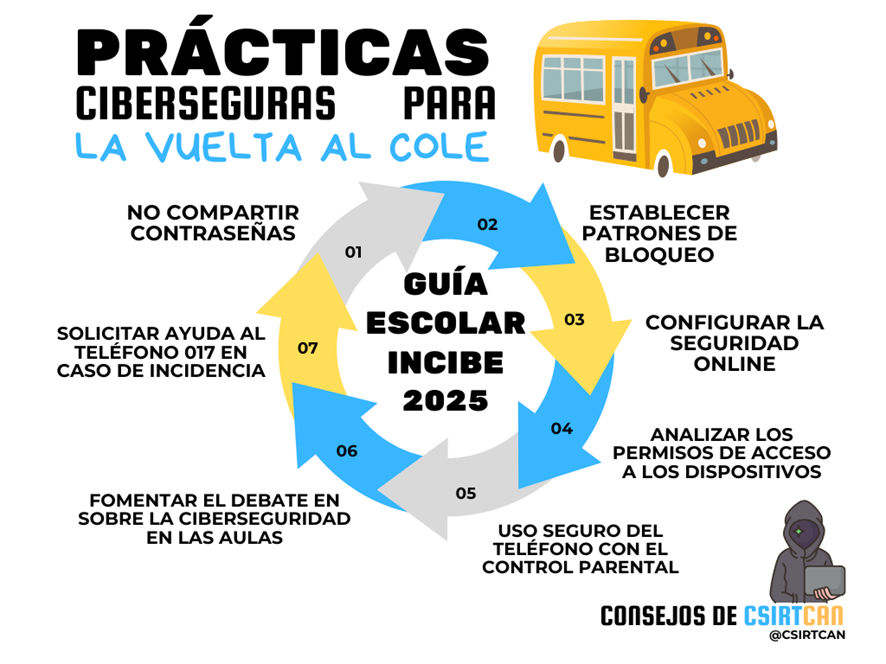
- The number 017 has been set up to report any online problems, so minors are protected with the help of INCIBE.
- Keep students informed about support organisations in case of online attacks.
- Approach the digital environment without fear to promote safe and responsible use among minors.
- Show interest in how minors in the family use their devices.
- Establish rules of use through dialogue and reach agreements within the family. This will help them understand the dangers of exposure to the internet.
- Use tools such as parental controls to monitor usage times.
INCIBE has presented a guide of activities to integrate digital skills into the Tutorial Action Plan. Divided into the various primary and secondary school courses, it presents effective measures to protect minors from exposure on the internet.
The initiatives include activities to show students safe habits for protecting devices:
- Do not share passwords.
- Set up unlock patterns.
- Configure the security of online accounts.
- Review the permissions they have granted to their devices.
- Expose them to fake news so they can reflect on it.
- Talk to them about concepts such as sexting, sextortion and other inappropriate content.
- Help them question the authenticity of their relationships on social media.
- Create discussions about the use of apps.
INCIBE's work is essential in protecting educational centres. Protecting students in the digital world is just as important as protecting them in the classroom. Cybersecurity practices help to create a citizenry that is aware of online threats.